What is the ka-band on antenna systems?


The Ka-band is a frequency range in the microwave portion of the electromagnetic spectrum, typically defined as spanning from 26.5 to 40 GHz. In the context of antenna systems, the Ka-band is significant because it is widely used for high-bandwidth communication applications, such as satellite communications, radar systems, and some terrestrial wireless systems.

Key Aspects of Ka-Band in Antenna Systems:

  1. High Frequency, Short Wavelength:
    • The Ka-band’s frequencies correspond to wavelengths of about 7.5 to 11.3 mm. These shorter wavelengths allow for smaller antenna sizes compared to lower-frequency bands (like C-band or Ku-band), while still achieving high directivity and gain.
  2. Applications:
    • Satellite Communications: Ka-band is commonly used for high-throughput satellites (HTS) because it supports higher data rates, enabling services like broadband internet (e.g., Starlink, Viasat).
    • Radar: Its high resolution due to the short wavelength makes it suitable for precision radar systems, such as weather monitoring or military applications.
    • 5G and Wireless: Some Ka-band frequencies are explored for millimeter-wave 5G networks.
  3. Antenna Design:
    • Parabolic Dishes: Ka-band satellite systems often use parabolic reflector antennas to focus the signal, requiring precise alignment due to the narrow beamwidth.
    • Phased Arrays: Modern Ka-band systems may employ phased-array antennas for beam steering, especially in mobile or space applications.
    • Smaller Size: The higher frequency allows for compact antennas, which is advantageous for portable or space-constrained systems.
  4. Challenges:
    • Atmospheric Attenuation: Ka-band signals are more susceptible to rain fade and atmospheric absorption (e.g., by water vapor or oxygen), requiring robust signal amplification and error correction.
    • Line-of-Sight: The short wavelengths mean Ka-band systems typically require a clear line of sight, limiting their use in obstructed environments.

In summary, Ka-band is a critical frequency range for advanced antenna systems, balancing high data capacity and compact designs with challenges like signal attenuation. It’s a cornerstone of modern satellite and radar technologies.
Smoked Beef Brisket on a Kettle Grill Using the Snake Method


Ingredients

  • 1 whole packer brisket (12–16 lbs, Prime or Choice grade)
  • Salt
  • Coarse black pepper (16-mesh ideal)
  • Optional: garlic powder, onion powder, paprika for rub variation
  • Wood chunks/chips (hickory, oak, or post oak for Texas-style; soak chips if using)
  • Hot water (for the pans)
  • Optional for wrap: beef broth, tallow, or butter
  • Heavy-duty aluminum foil or pink butcher paper

Equipment

  • Barrel smoker or Kettle grill (22″ or similar)
  • Charcoal briquettes (Kingsford or similar)
  • 2 small aluminum foil pans
  • Instant-read thermometer (Thermapen or similar)
  • Heavy-duty foil
  • Cooler + towels for resting

Instructions

  1. Prep the Brisket (day before or morning of)
    • Trim excess hard fat, aim for ¼-inch fat cap. Square up edges if desired.
    • Apply simple rub: 50/50 salt and coarse black pepper (about ½ cup total for a 14-lb brisket). Coat generously on all sides.
    • Rest uncovered in fridge 4–12 hours (overnight ideal) for better bark formation.
  2. Set Up the Snake Method
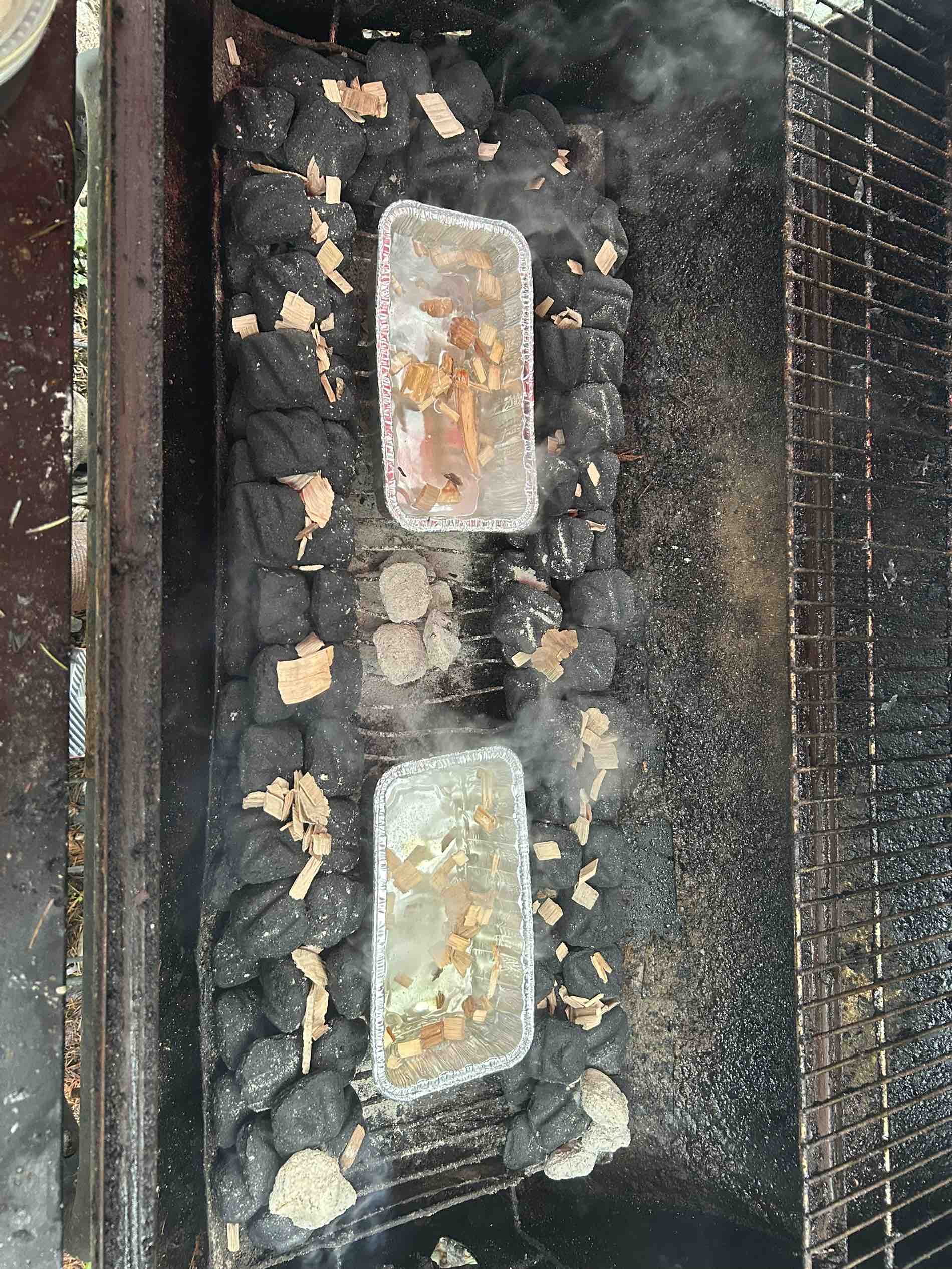
    • Arrange briquettes in a semi-circle (snake) 2 briquettes wide and 2 high along half the perimeter of the grill.
    • Place a few wood chunks on top of the briquettes along the snake.
    • Fill 2 small aluminum pans with soaked wood chips/chunks (or dry chunks) and add hot water to one or both pans for extra humidity and temperature stability.
    • Place the pans directly in between the briquettes near the start and middle of the snake for steady smoke.
    • On a barrel smoker you might want to light both ends (left and right) to heat the long space evenly.
    • Light 8–10 briquettes in a chimney. Once fully lit, place them at one end of the snake to start the slow burn.
  3. Start the Cook
    • Place brisket on the grate fat side up or down (both work; fat up renders into meat, fat down shields from heat).
    • Position it in the center, away from the snake.
    • Close lid, adjust vents to hold 225–250°F (bottom vent ¼–½ open, top vent half open).
    • No need to flip or rotate unless one side gets noticeably hotter.
  4. Smoke Unwrapped (Bark Building Phase)
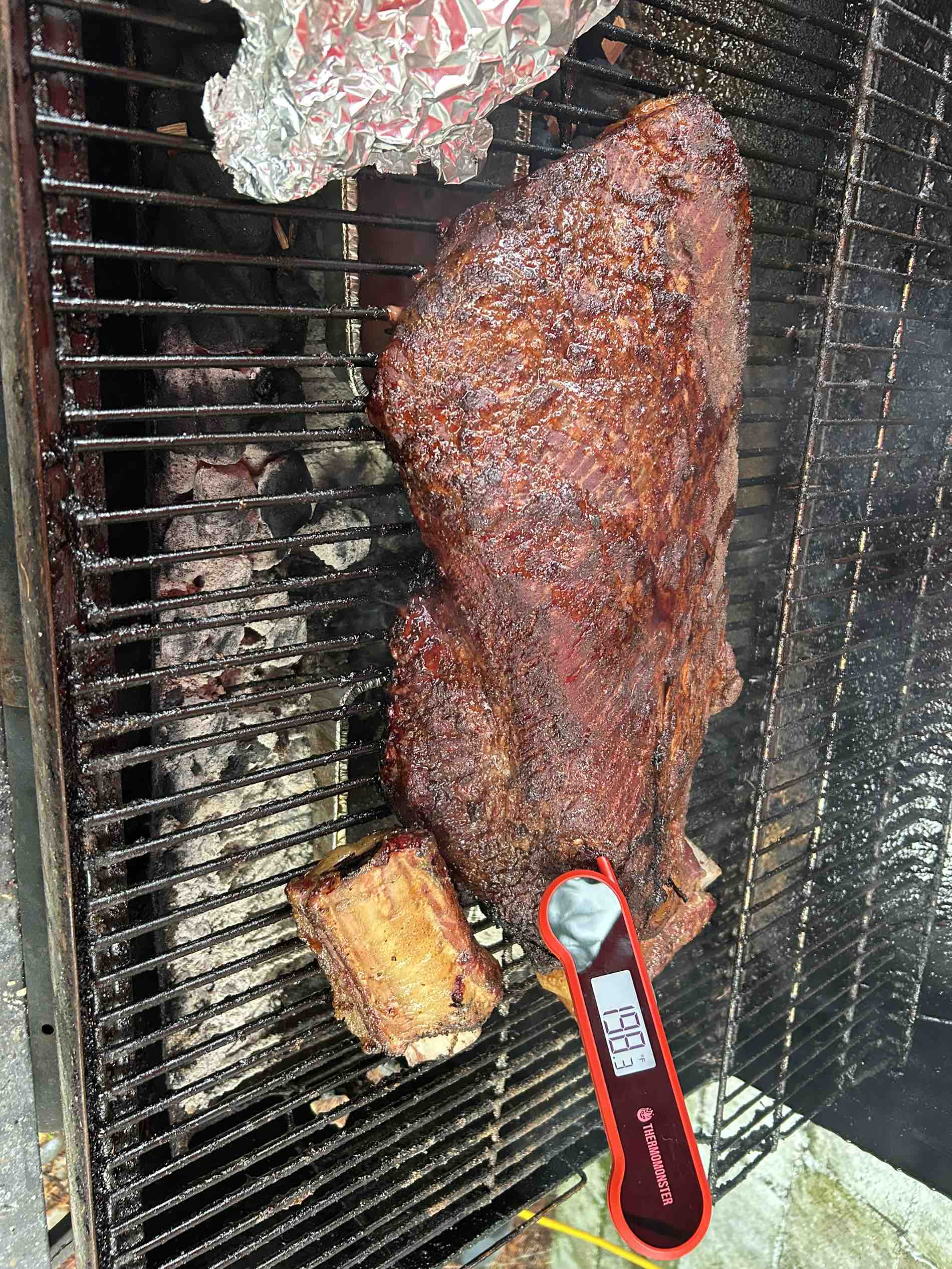
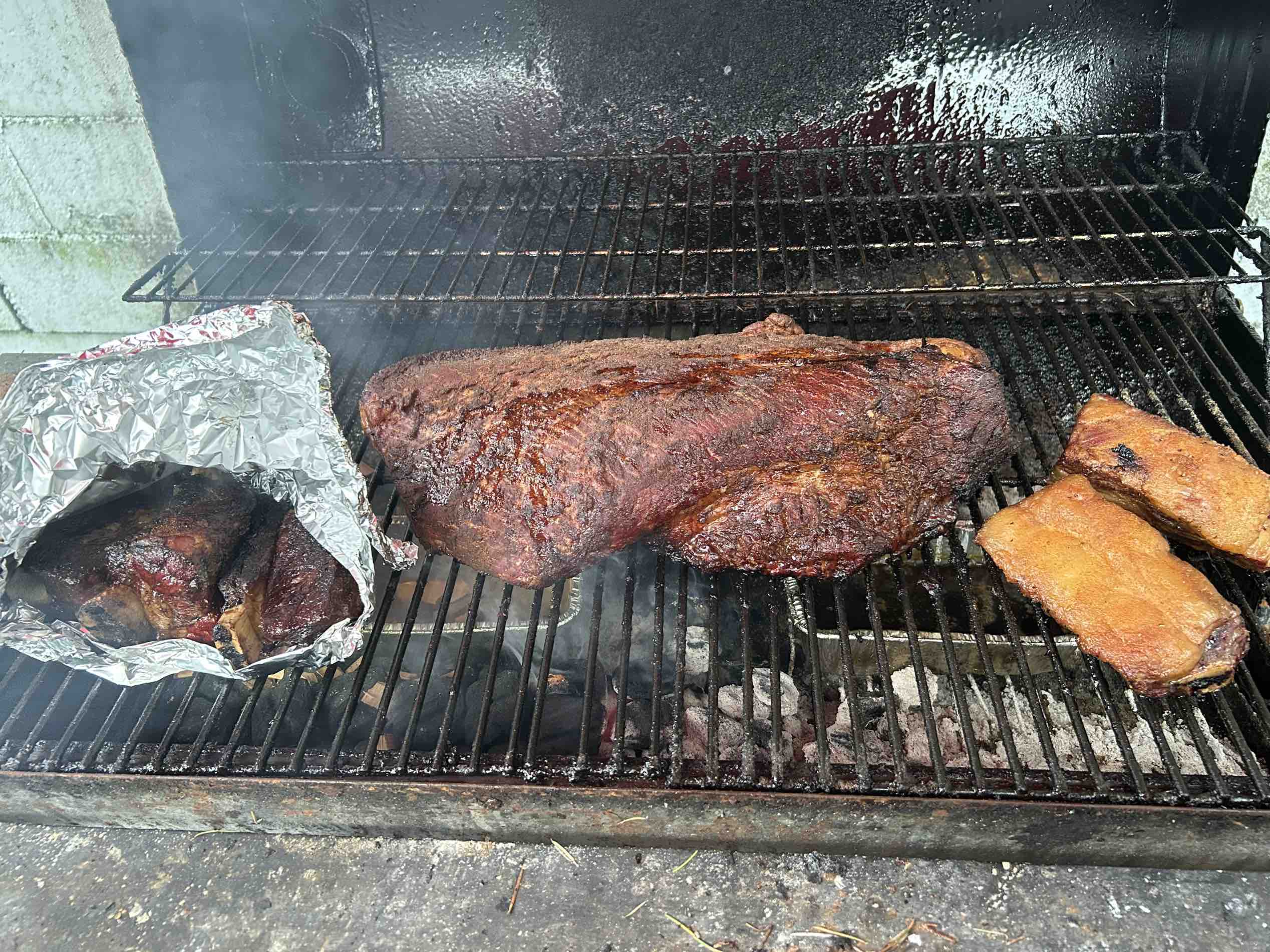
    • Cook unwrapped for first 5–7 hours or until bark is deep mahogany and internal temp hits ~160–175°F.
    • Expect the stall around 150–170°F. Keep lid closed as much as possible.
    • Add more wood/hot water to pans if smoke or moisture dies down.
  5. Wrap (Texas Crutch)
    • When bark looks perfect, wrap tightly in heavy-duty foil or butcher paper.
    • Optional: Add ¼ cup beef broth or a few pats of butter/tallow inside wrap.
    • Return to grill and continue cooking at 225–250°F.
  6. Finish the Cook
    • Cook wrapped until internal temp reaches 195–205°F in the thickest part of the flat.
    • Most important: Probe for tenderness — thermometer should slide in like soft butter with almost no resistance.
    • Total cook time: ~1–1.5 hours per pound.
  7. Rest
    • Leave wrapped (or double-wrap).
    • Place in a dry cooler wrapped in towels.
    • Rest minimum 1 hour, ideally 2–4 hours (it will stay hot for 5+ hours).
  8. Slice & Serve
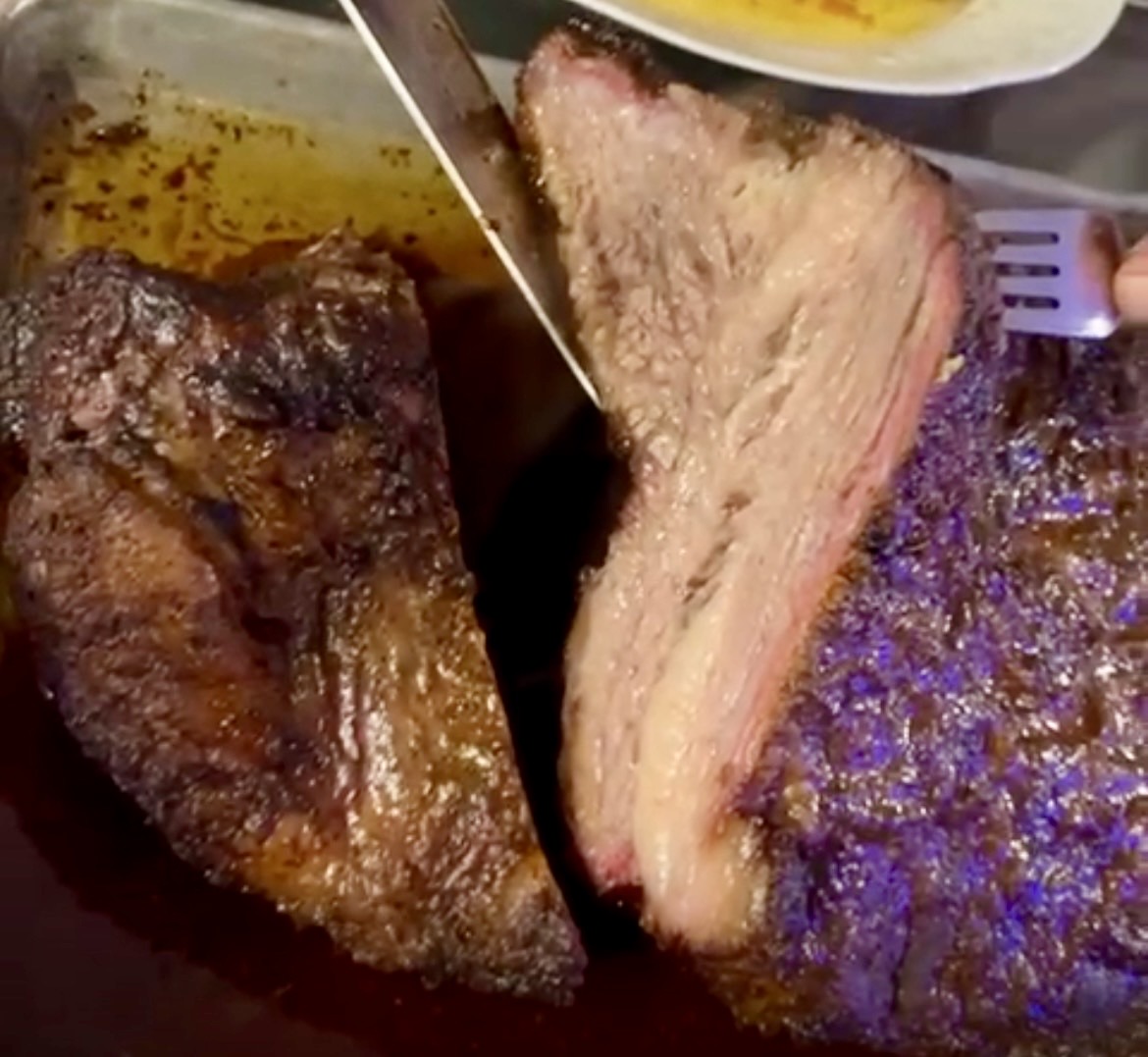
    • Unwrap, separate point from flat if desired.
    • Slice against the grain — flat one direction, point the other.
    • Serve with burnt ends from the point if you cube and sauce them.
Screenshot

Tips for Success

  • Monitor grate-level temp, not just lid thermometer.
  • Thin blue smoke is ideal — white smoke means dirty fire.
  • Using hot water in the pans helps stabilize temperature and keeps the environment moist for juicier results.
  • If temp spikes, close vents. If too low, open slightly or add a few lit briquettes.
  • This method gives competition-level bark and juiciness on a simple kettle.

Next day tip:

Toast some bread and make sandwiches with thin slices of cold brisket, topped with ioli mayonnaise or chimichurry.

Enjoy.

Aioli / Garlic Mayonnaise


Ingredients:

2 eggs
2 garlic cloves (peeled)
Ground pepper (a pinch, black or white)
Salt to taste
Oil (neutral, like sunflower, canola, or light olive oil – about 200-300 ml, added gradually)
Lemon juice (to taste, about 1-2 tablespoons)

Method:

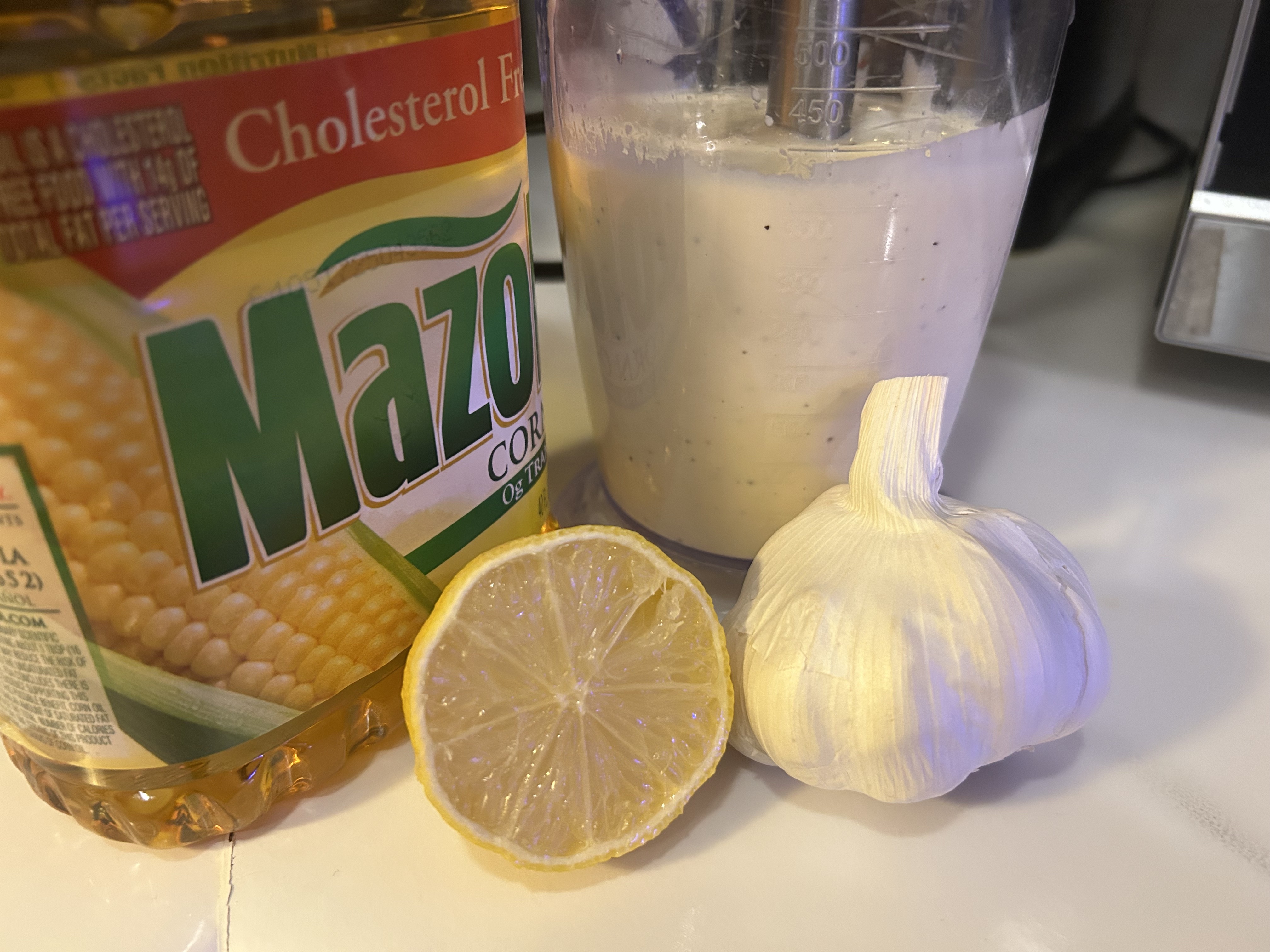
In a tall, narrow container (ideal for the hand blender), add the two eggs, the two peeled garlic cloves, a pinch of pepper, and salt to taste.

Start blending with an immersion blender (minipimer/hand blender) held at the bottom. Slowly pour in the oil in a thin, steady stream (like a drizzle) while keeping the blender running and moving it up and down slightly as the mixture emulsifies and thickens.


Continue blending until it becomes thick and creamy. Finally, add lemon juice to taste, blending a bit more.

Taste it to check the seasoning – adjust salt, lemon, or even add more garlic if needed.

When ready, transfer to a container and refrigerate covered with plastic wrap (directly touching the surface to prevent a skin from forming).

Always return it to the fridge covered with plastic wrap after use.

Consume within 4-5 days maximum due to the risk of salmonella from raw eggs.

Dill Pickle Recipe


INGREDIENTS:

12-14 Persian cucumbers or 8-10 pickling cucumbers

4 garlic cloves, halved

2 teaspoons of mustard seeds

2 teaspoons of peppercorns

a few good-sized dill springs, per jar

2 cups of water

2 cups of distilled white vinegar

1/4 cup of cane sugar

2 tablespoons of sea salt

INSTRUCTIONS:

  1. To make dill pickle spears, slice the cucumbers lengthwise into quarters. To make dill pick chips, thinly slice them horizontally
  2. Divide the cucumbers among 4 (8-ounce) or 2 (16-ounce) jars. Divide the garlic, mustard seeds, peppercorns, and dill springs among each jar.
  3. Heat the water, vinegar, sugar, and sea salt in a medium saucepan over medium heat. Stir until the sugar and salt dissolve, about 1 minute. Let cool slightly and poor over the cucumbers. Set aside to cool to room temperature, then store the pickles in the fridge.
  4. Pickle spears will be lightly pickles in 2 days, but the best flavor will start to develop around day 5 or 6. Pickle chips will be lightly pickled in 1 day, and will become more flavorful every day after that. Store in the fridge for several weeks.

Pasta Frola


Ingredientes:

1 taza de azúcar (200 gramos)

1 1/2 tapas de harina leudaste (300 gramos)

1 huevos entero, 2 yemas

100 gramos de manteca

1 cucharadita de esencia de vainilla

1 pizca de ralladura de limón

400 gramos de dulce de membrillo

Utensilios:

Molde

Espátula de silicona

Bowl

Tamizador

Instrucciones:

Mezclar en un bol el azúcar con la manteca a temperatura ambiente. Incorpora los huevos uno por uno, y la esencia de vainilla y la ralladura le limón. Poco a poco tamizar, añadir, y juntar la maza.

Vuelca la maza en una superficie enharinada y amasa hasta obtener una masa blanda, deja la masa en la nevera por 30 minutos aproximadamente.

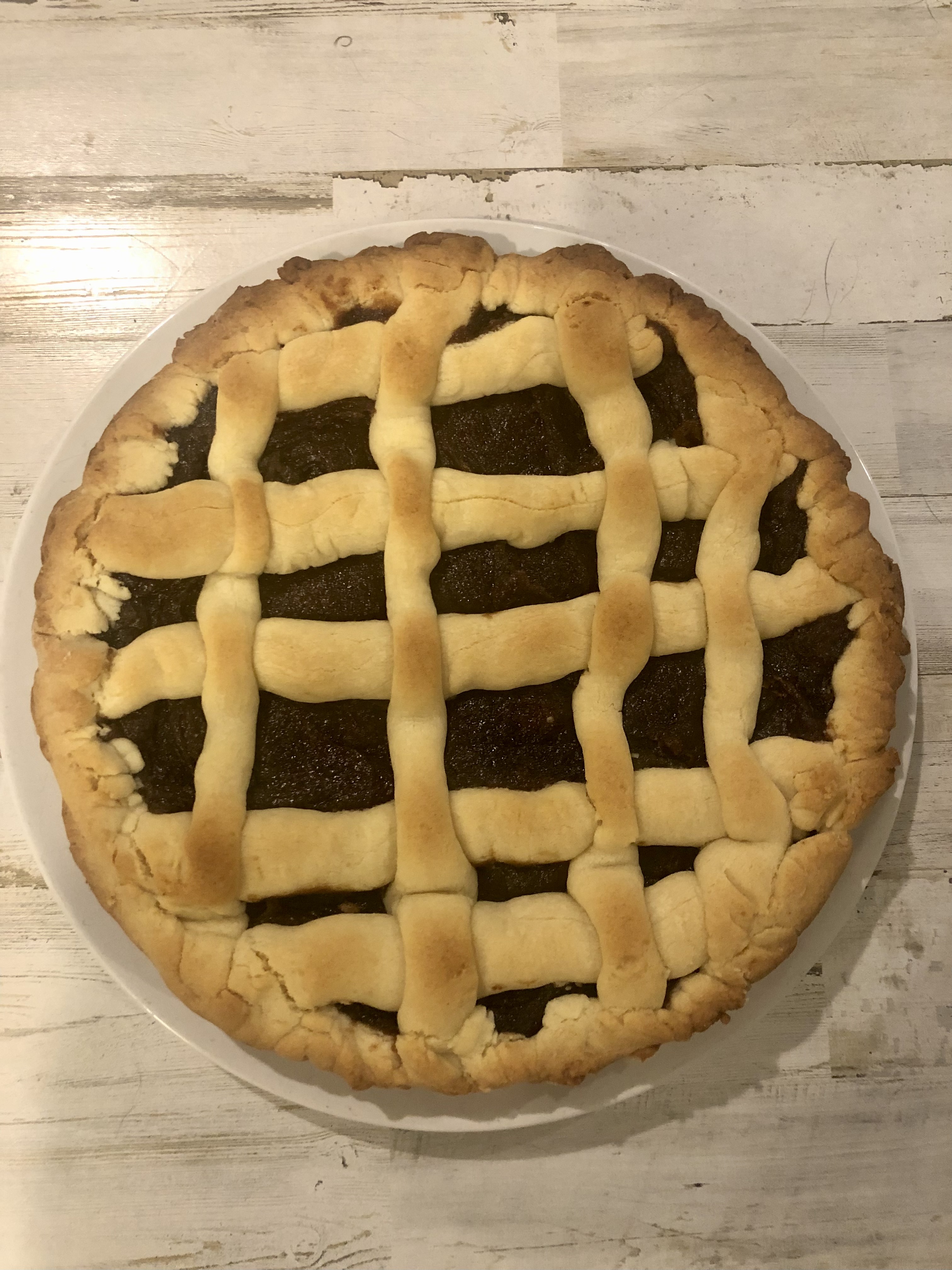
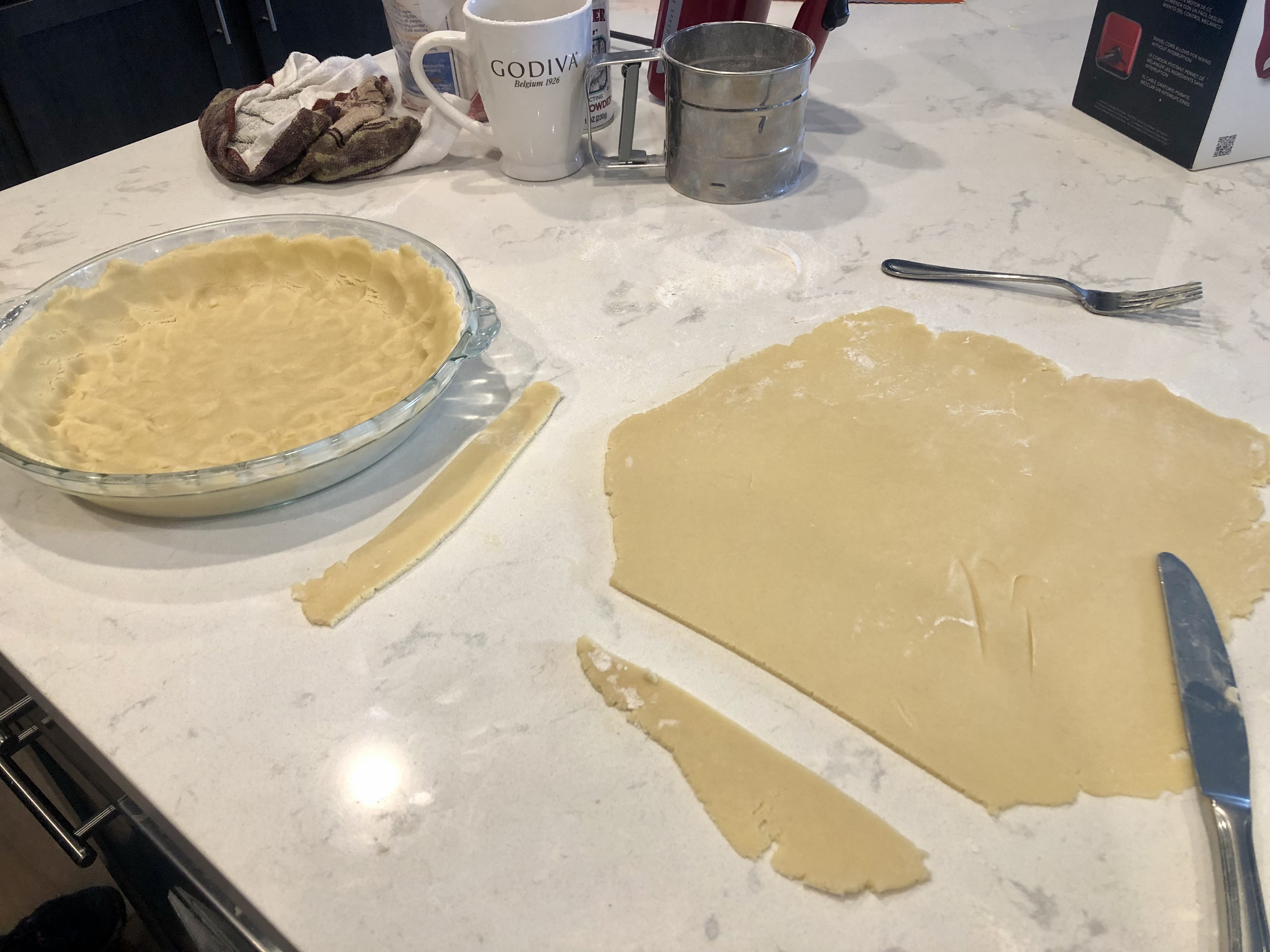
Engrasa y espolvorea con harina un molde para horno, y entiende la masa con los dedos. Agrega el membrillo sobre la base de masa de pasta frola que ya has preparado, espárcelo bien por todas partes y cúbrelo con tiras de masa para decorar.

Temperatura de el orno es 350 F esta que este dorado o 20 o 30 minutos.

Keto Danish Butter Cookies (30 cookies)


Equipment

  • Baking Sheet
  • Mixing Bowls

Ingredients

  • 1.25 cups almond flour
  • 1/4 cup coconut flour
  • 1/3 cup Low Carb Sugar Substitute
  • 1 tsp baking powder
  • 6 tbsp butter, room temperature
  • 1/2 tsp vanilla extract

Instructions

  • Preheat oven to 350°F and line a baking sheet with parchment paper or a silicone mat. 
  • In a mixing bowl, combine almond flour, coconut flour, erythritol, and baking powder; mix well using a spoon.
  • Cut in the butter and vanilla and work it with your fingers until a dough forms.
  • Use your hands to roll the dough into 12 equal balls. Place the balls 2-inches apart on prepared baking sheet. Use a fork to flatten and create a striped pattern.
  • Bake the cookies for 11-14 minutes, or until browned around the edges. Transfer to wire rack to cool.
  • Best stored in an air tight container or zip top bag in the fridge up to 10 days.

Notes

Net Carbs: 2g per servingYields: 12 Cookies

Nutrition

Calories: 128kcal | Carbohydrates: 4g | Protein: 3g | Fat: 12g | Fiber: 2g

mplayer seamless loop in Raspberry Pi


Have you ever tried to run a video on an infinite loop with mplayer?

You will find that most players (including VLC) will do a ‘restart’ after each loop. That stuttering is very annoying when you are trying to build a kiosk mode screen display.

We can achieve a seamless infinite video loop with mplayer with a command like this:

mplayer -fs videofile.xyz -loop 0

Please note the “-loop 0” option is at the end. If you put this option before the file name, it will cause a restart on every loop. Apparently, this behavior comes from a very old quirk

Get 16v out of a MagSafe2 Apple Charger


If you read the specs for a MagSafe2 Apple Charger, it says output 16.6V 3.5A, which can be useful when you are looking for a 12V source power for i.e. a battery.

But, if you just cut the Magsafe2 cable and measure the voltage, you’ll read only around 0.3V.

What’s the trick?

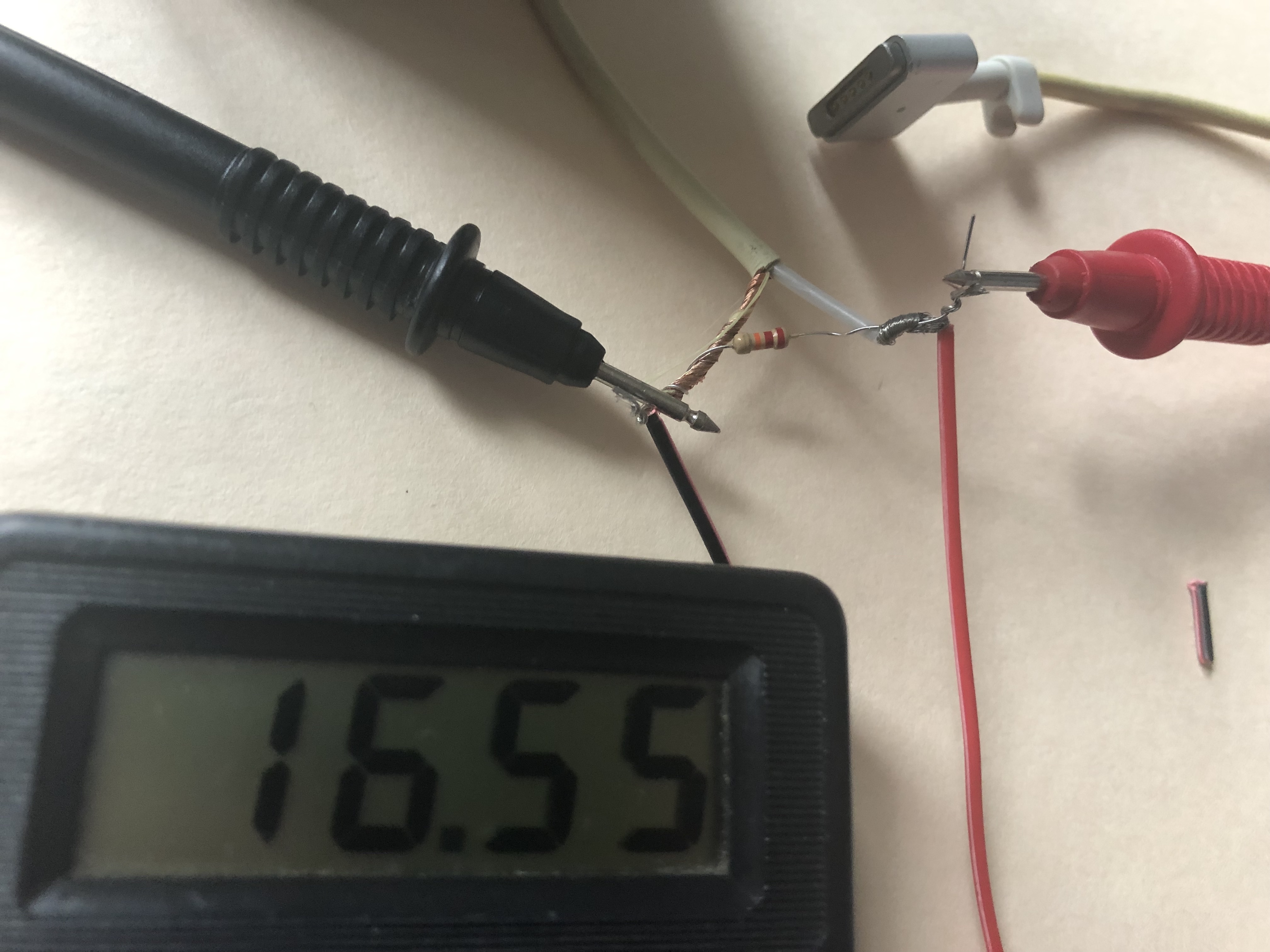
This charger has an internal 16-bit microprocessor. You need to put a resistance between both terminals (i.e. 22K Ohm), to tell the microprocessor that there is a resistive load between terminals (same does your mac when you plug it).

When the microprocessor registers this load, after 1 second, it will deliver the 16V.

Now you can use this charger to regulate the output (maybe using an lm2596) and charge a 12V battery…

More information: http://www.righto.com/2013/06/teardown-and-exploration-of-magsafe.html

12V Battery Charging


Measuring current to detect when the battery is fully charged:

In normal (old age) battery chargers there will be the Ammeter connected in series between the battery and the battery charger.

When the battery is almost full. The current will gradually descend near zero. Because both voltages are almost the same. Until the current flows less.

Due to the V = IR rule, if the charging voltage V increases. It will cause the charging current (I)to decrease.

In modern battery charging circuits, The battery voltage will be measured. When the voltage is indicated that the battery is fully charged. The system will automatically cut off the power more convenient.

Reference: https://www.eleccircuit.com/how-many-amps-hours-to-charging-battery-full/

Flush DNS on Mac


Making DNS changes and wanting to force a flush on a Mac?

Here are the commands for the different mac versions:

MacOS VersionCommand
macOS 12 (Monterey)sudo dscacheutil -flushcache; sudo killall -HUP mDNSResponder
macOS 11 (Big Sur)sudo dscacheutil -flushcache; sudo killall -HUP mDNSResponder
macOS 10.15 (Catalina)sudo dscacheutil -flushcache; sudo killall -HUP mDNSResponder
macOS 10.14 (Mojave)sudo killall -HUP mDNSResponder
macOS 10.13 (High Sierra)sudo killall -HUP mDNSResponder
macOS 10.12 (Sierra)sudo killall -HUP mDNSResponder
OS X 10.11 (El Capitan)sudo killall -HUP mDNSResponder
OS X 10.10 (Yosemite)sudo discoveryutil udnsflushcaches
OS X 10.9 (Mavericks)sudo killall -HUP mDNSResponder
OS X 10.8 (Mountain Lion)sudo killall -HUP mDNSResponder
Mac OS X 10.7 (Lion)sudo killall -HUP mDNSResponder
Mac OS X 10.6 (Snow Leopard)sudo dscacheutil -flushcache
Mac OS X 10.5 (Leopard)sudo lookupd -flushcache
Mac OS X 10.4 (Tiger)lookupd -flushcache